-2.png?width=132&height=32&name=slatecx-logo%20(1)-2.png)

Customer Experience
The New CX Job Starts Before the Sale. Most Sites Are Failing It.

Callan Schebella
The New CX Job Starts Before the Sale. Most Sites Are Failing It.
6:37
I spent my career building conversational AI for the contact center. I have seen every way a company can make it hard for a customer to get a straight answer, and every way technology can make it easy. So when we reviewed the results of our new study, the Buyer Answer Gap, one thing was obvious to me that might not be obvious to a marketer: this is a CX problem. And it starts earlier than most CX teams are looking.
CX moved upstream, and the front door moved with it
For years, customer experience meant everything that happened after the sale: service, support, retention. The contact center was the front door and the finish line at the same time. That is the world I came up in.
That is not the job anymore. Modern CX leaders own every touch point, pre-sale, post-sale, and everything in between. The entire point of a good CX strategy is to make the experience so smooth that the customer never needs to call the service line in the first place. Which means the first CX moment now happens long before anyone buys anything. It happens the first time a buyer lands on your website with a real question.
On most B2B sites, that first moment is a failure.
The pre-sale experience is the first CX moment
If you answer a buyer's question the first time they visit, you have done three things a CX leader cares about. You have reduced the number of times they will need to call support later. You have set an accurate expectation. And you have started the relationship on your terms, not someone else's.
Most sites do not. Buyers arrive with real questions, cannot find real answers, and leave. Where they used to book a meeting or call in, they now open ChatGPT. And whatever ChatGPT tells them becomes the truth they carry into every future interaction with your company, a truth you never got to shape.
By the time that buyer becomes a customer, if they ever do, your CX team inherits a relationship built on an AI's secondhand summary of a vendor it never actually spoke to. That is not a marketing problem. That is a CX problem, and it is the most preventable one you have.
What we measured, and what we found
We built a set of realistic buyer questions across common B2B categories: how the product actually works, what it costs, how it integrates, how it compares to a named competitor, what happens after the contract is signed, how hard it is to deploy. Some of the exact questions a contact center agent fields every day, just moved to the pre-sale stage. We ran them through 130 B2B vendor websites and their chatbots, and scored whether the answers were direct, accurate, and useful to a real buyer.
Three findings stood out.
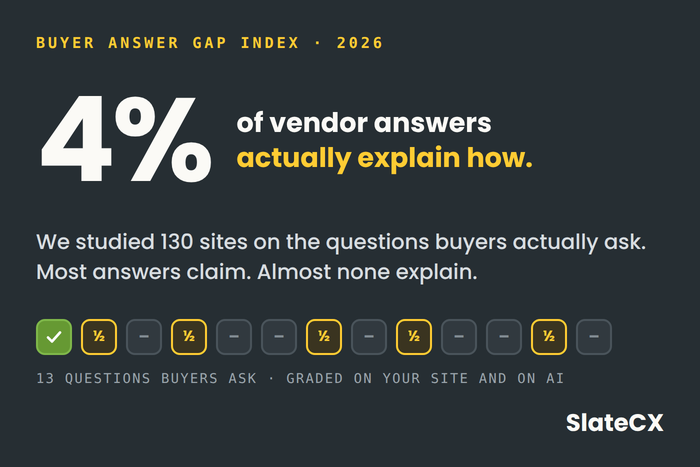
First, most sites do not answer the questions that decide a deal. They make claims, but only 4% actually explain how the product works. Only 6% explain why to choose them over a competitor. Not one gave a buyer a real payback for a company their size. Pricing was hidden. The post-sale reality, implementation, support, what breaks, was rarely mentioned.
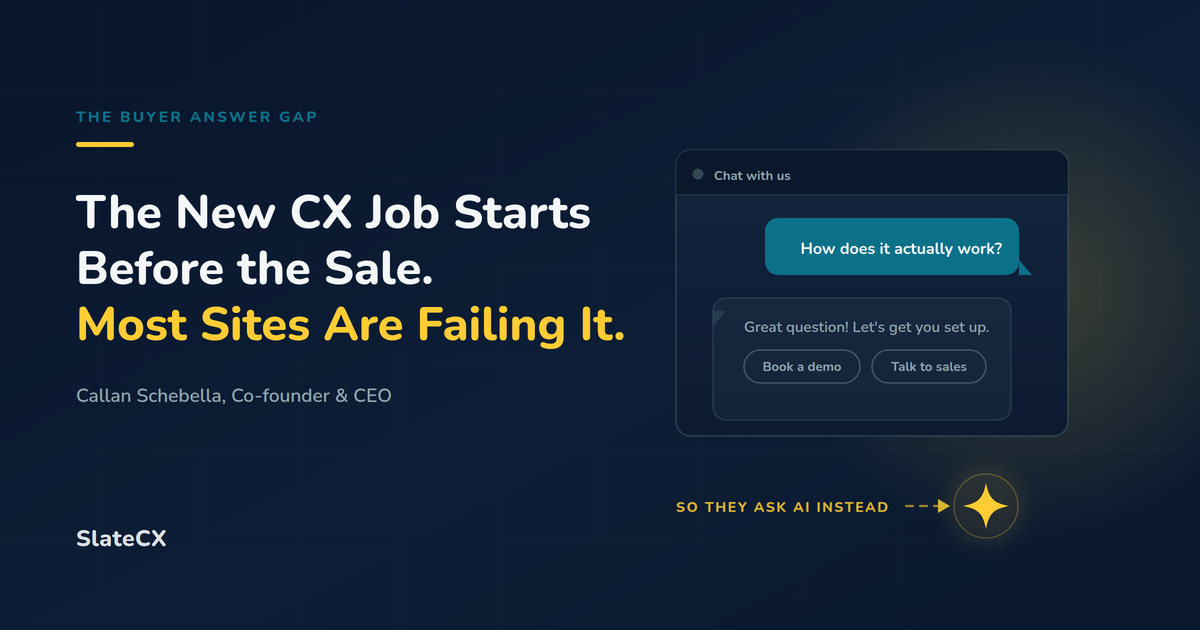
Second, most sites had no chatbot a buyer could use. Only 5% had one a buyer could actually open, ask a real question, and get a real answer from. The rest were missing, or installed and switched off: a widget that never opens, a row of buttons that routes to "book a demo," a live chat sitting offline, a form that wants an email before it will say a word. Any CX leader will recognize this instantly. It is the same failure as an IVR that loops the caller back to the main menu.
Third, a small number of chatbots worked, and the ones that did worked well. Several answered even the hard questions, the way a real buyer needs. The technology works when someone turns it on and points it at buyers. Almost no one has.
Why CX leaders are the right people to fix this
Marketing has been trying to close this gap by making more content. It has not worked, because the gap is not a content problem. It is an experience problem. And CX leaders understand experience problems better than anyone in the building.
The same instincts that fixed the post-sale experience are exactly what the pre-sale experience needs. Design for the moment the customer is actually in. Route them to a real answer, not more content. Measure success by whether they got what they came for, not by how many assets they downloaded on the way.
And the AI SDR or chatbot decision is a CX decision, whatever the org chart says. Whether that bot answers well or fails silently is a customer experience question. Marketing may have bought it. CX lives with the consequences.
What happens if CX does not step in
The customer journey is now one connected experience: exploration, evaluation, deployment, onboarding, all of it before anyone calls support. If the early part goes badly, the customer reaches your service team already unhappy, carrying wrong assumptions that a competitor or an AI set for them. Every wrong assumption becomes a support call, a churn risk, or a lower renewal.
That is not a marketing problem showing up in marketing's numbers. It is an experience problem showing up in yours.
Three things a CX leader can do this week
1. Grade your own website. We built a free tool that runs the same test we used in the research and scores how well your site answers buyer questions.
2.Grade your chatbot, if you have one. Look at the result with fresh eyes and decide whether that is really what your future customer is experiencing.
3. Take it to your marketing counterpart. Frame it the way you would frame a contact center audit, not as blame, but as a shared problem. Marketing owns the content. You own the experience. Neither works unless both do.
The takeaway
The modern CX job is to shape every touch point a customer has with your company, starting long before they buy. The pre-sale experience is the first place that job is being fumbled, and the most preventable. The companies that fix it will not just win more deals. They will start every customer relationship on a foundation that does not quietly generate support calls and churn six months later.
I spent a career helping companies answer their customers faster. The next frontier is answering them before they are customers at all.
Callan Schebella is co-founder and CEO of SlateCX, a B2B buyer engagement platform. He has spent his career building conversational AI, and previously co-founded Inference Solutions, acquired by Five9.