-2.png?width=132&height=32&name=slatecx-logo%20(1)-2.png)

B2B SaaS websites can't answer the questions that close the deal.
Your chatbot isn't there to catch them. So buyers ask AI, which reads the same thin pages and comes up empty too.
A buyer evaluates you in three places now: your website, the chatbot on it, and the AI they ask about you. We studied ~130 B2B SaaS companies across all three. Most sites answer the easy questions and go quiet on the ones that decide the deal. Almost no vendor has a chatbot a buyer can use. And AI answers anyway, reading the same thin pages and coming up just as empty. (Of the ~130, 108 produced a clean site grade; the rest were held back rather than failed, so the site percentages below are based on those 108.)
The evaluation is happening without you.
Two thirds of B2B buyers now say they would rather buy without ever talking to a sales rep. Gartner found 45% used AI in their last purchase, and our own survey of 205 buyers and sellers found 41% start their research with AI instead of a search engine.
It is tempting to read a missing answer as good news: if a buyer can't find it online, surely they have to call you. They don't. A buyer who can't get the answer doesn't raise their hand. They ask AI, take whatever comes back, and move on. You don't get a call. You get dropped from the shortlist, and you never learn you were on it.
You can see it most clearly on the one question that decides the deal: why you over the competitor. Almost no site answers it, so AI has nothing of yours to work from. The buyer gets a verdict pieced together from review sites and rival comparisons, then decides on it. Your own case for yourself never reaches them, and they never call to ask for it. We show one of those answers, exactly as it came back, further down.
The questions that decide the deal are the ones you don't answer
The median site answers half a buyer's questions. But the gap isn't even. It's concentrated exactly where it costs the most.
Almost every site answers the opening questions: what problem you solve, who uses you, proof you've worked for companies like the buyer. But table stakes don't shortlist anyone. What decides whether you advance is the next layer down, the questions that turn an evaluation serious, and that is where the floor drops out.
We looked for all 13 answers on 108 sites. Here's how often a buyer could find each one.
Each bar is the share of sites where a buyer could actually find that answer in the pages. The questions every site answers sit at the top. The deal-deciding ones sit at the bottom, where the answers run out.
The pattern is the finding. The further a question gets from the pitch and the closer it gets to "should we actually buy you," the more likely the site is silent.
And "answered" is generous, because most of what a buyer finds is a claim, not an explanation. A logistics platform says it puts "pricing, planning, execution, and billing all in one place." A payroll vendor promises to "run global payroll with a single click." Claims of the result, with no how. Only 4% of answers explain the mechanism, the one thing a buyer needs to believe it will work for them.
Answering isn't explaining
Here's that split across every answer we looked for. Of every 100:
Take the question buyers ask most directly, how does it actually work. 39% of sites say something. Not one explains the mechanism.
This isn't a handful of laggards. Two thirds of the sites we graded never once explained how their product works. The best single site managed three questions out of thirteen.
The chatbot you put there for this exact moment mostly isn't there
A buyer who can't find the answer looks for someone to ask. Plenty of vendors installed a chatbot or "AI SDR" for precisely that. Almost none of them actually answer a buyer.
We took every company in the study that showed any sign of chat technology and tested it by hand, the way a buyer would: open the homepage, find the chat, ask the same questions. Most companies had no chatbot at all. Of the ones that did, almost all had it installed but switched off for buyers, a widget that never opens, a row of buttons that routes to "book a demo," a live chat sitting offline, or a form that wants an email before it will say a word.
And the seven that worked were good. Several answered even the hard questions, security evidence, integrations, a tailored payback, the way a buyer needs. That's the point, not a footnote: the technology answers buyers well when someone turns it on and points it at them. Almost no one had. So the buyer, still holding the question that decides the deal, has nowhere on your turf left to ask it. They leave.
When your pages come up empty, so does AI
With your site quiet and your chatbot dark, the buyer does the one thing left. They ask AI. And AI does answer more often, a median of 81% coverage, far above your site's 50%. But more often is not better. AI gives a real, specific answer only 19% of the time. The rest is a vague gist of your own content, because AI is reading the very same pages your buyer does and hitting the very same gap. The evaluation just moved to a surface you can't see.
So on the one question that most decides the deal, the comparison gets shaped as much by review sites as by you. You didn't lose the argument. You barely showed up to make it.
This study asked AI about specific, named vendors: how does this company work, what is its ROI, why it over a rival. On that question, AI goes to the vendor's own site, which is why almost all of its answers came from vendor content. That is the failure this report measures: your pages are on the surface AI reads, and they are thin.
There is a second question we did not measure: the broad "what is the best tool for X" search, where no vendor is named. With no single site to read, AI builds its shortlist from third-party sources, G2, Gartner, Reddit, comparison blogs. That is a different problem, and it happens earlier: not whether your pages answer, but whether you make the list at all. Both matter. This report is about the first.
This broad-versus-narrow behavior is an observed pattern, not a number from this study, and it varies by model and shifts over time.
Being big doesn't help. The largest companies answered the worst.
The obvious assumption is that well-resourced enterprises, with big content teams, do this better. They did it worse.
| Segment | Companies | Answered on site (median) | Explained how |
|---|---|---|---|
| Mid-market (250–999 employees) | 64 | 54% | 5% |
| Enterprise (1,000+) | 27 | 38% | 3% |
The larger companies answered fewer of a buyer's questions on their own sites than mid-market did. They also blocked our crawler more often, a quarter of them versus one in seven, because the answers are buried so deep behind gates and portals that an automated buyer, the kind that now does the first pass, can't reach them either. More resources didn't produce more answers. It produced more places to hide them.
And some deal-deciding questions no website can answer
A few of the questions that most decide a deal can't be answered by any page, because the answer depends on the buyer's own numbers. The payback for a company their size. What actually changes for their team six months in. We asked these too, and held them to a fairer bar, half credit at best, because no static public page can truly answer them.
No site gave a full answer to either. One in five gestured at it with a generic claim, the kind of "15 to 30% lower cost" figure that isn't the buyer's number. The rest said nothing. This is the one place a static page was never going to win, and it's exactly where a live, tailored conversation should take over. But that conversation has to be running, and on the companies we tested, almost none was. The page couldn't answer, AI could only generalize from public scraps, and the chatbot that should have picked it up wasn't switched on. Three surfaces, and the buyer's most important question goes unanswered on all of them.
A few showed it can be done. The fix isn't exotic.
The site actually explains
One vendor's security page didn't say "enterprise-grade security." It listed the evidence: SOC 2 Type 2, ISO 27001, annual third-party penetration testing, encryption at rest, named infrastructure. A buyer's security team can act on that.
When your site answers, AI grounds in you
On an integration question, AI returned a real answer and cited the vendor's own pages, its press release, its FAQ. Not a third-party guess. Coverage on your site becomes a grounded answer from AI.
The chatbot, switched on
A handful of vendors had a chatbot that actually answered: it named real customers, walked through how the product works, and gave a payback figure tied to the buyer's own size, citing the vendor's own sources. Same widget that sits dark on most sites, pointed at buyers and turned on. The silence is a choice. So is owning the answer.
Find out what a buyer can't get from you.
Grade your site in seconds to see your two scores, what's answered, what's missing, and where AI is filling the gap with someone else's content. Then test your own chatbot the way we did, posing as a real buyer, to see what it actually answers.
Grade your site Test your chatbot Read the methodologyThe findings, in one place
- We studied ~130 US B2B SaaS companies across three surfaces: their website, their on-site chatbot, and general-purpose AI. 108 produced a clean site grade; the rest were held back rather than failed.
- Across those 108 sites, the typical site answered only about half of the 13 questions buyers ask while evaluating a vendor.
- The gap concentrates on the questions that decide the deal: sites answered only about a quarter of those, while clearing the easy, top-of-funnel ones.
- Only 4% of answers explained how the product actually works. The rest asserted an outcome without showing the mechanism.
- Just 6% of sites answered "why you over the competitor," the most decisive question in any evaluation. 94% said nothing.
- Most companies have no AI chatbot a buyer can actually use. Of the ~130 studied, only 7 surfaced one that could hold a real conversation. The rest were missing, dormant, menu-only, offline, or gated behind a form.
- When the site went quiet, AI produced an answer 81% of the time, but only 19% of the time was it real and specific. Almost all the rest was AI echoing the vendor's own thin pages, not content from strangers.
- On the comparison question, AI leaned on third-party review sites in about 83% of answers, usually alongside the vendor's own comparison pages. Everywhere else, AI drew on the vendor's own content far more than on third parties.
Common questions
Can B2B SaaS websites answer the questions buyers ask when evaluating a vendor?
Mostly not where it counts. In a 2026 study of 108 mid-market US B2B SaaS websites, the typical site answered about half of the 13 questions buyers ask while evaluating a vendor, but only about a quarter of the questions that decide the deal, such as how the product works, what it costs, and why to choose it over a competitor.
How often do B2B websites explain how their product actually works?
Rarely. Across 108 B2B SaaS websites, only 4% of answers explained the mechanism, how the product produces its result. The other 96% asserted an outcome, such as faster or cheaper or more secure, without showing how.
Do B2B websites answer "why choose you over a competitor"?
Almost never. Just 6% of the 108 B2B SaaS sites answered the "why you over the competitor" question on their own site. 94% said nothing, leaving the comparison to be written by review sites and rivals instead.
Do B2B vendors have a chatbot or AI SDR that can answer a buyer's questions?
Rarely. Of about 130 B2B SaaS companies studied, only 7 had an on-site chatbot a buyer could actually hold a conversation with. Most had no chatbot at all, and many that did had it installed but switched off for buyers: dormant, routed to a demo menu, offline, or behind an email form. The few that worked answered well, which shows the gap is a configuration choice, not a limit of the technology.
If a buyer cannot find an answer on a vendor's site, do they contact sales?
Usually not. Two-thirds of B2B buyers say they would rather buy without talking to a sales rep, and many start their research with AI. A buyer who cannot find an answer typically asks an AI assistant or a review site and moves on, so the vendor often never learns it was being evaluated.
How well does AI answer questions about B2B vendors?
It answers often but rarely well. Asked the same 13 buyer questions, AI produced an answer 81% of the time, but only 19% of those answers were real and specific. The rest were vague restatements of the vendor's own marketing.
Where does AI get its answer about how a vendor compares to competitors?
Mostly from a mix. On the "why you over the competitor" question, AI cited third-party review sites like G2, Capterra, and Gartner Peer Insights in about 83% of answers, usually alongside the vendor's own comparison pages. On other questions, AI drew on the vendor's own content far more than on third parties.
How was the Buyer Answer Gap Index measured?
SlateCX graded 108 mid-market US B2B SaaS websites against a frozen set of 13 questions buyers ask while evaluating a vendor, scoring each on two independent axes: whether a buyer could find the answer on the vendor's own site, and whether AI returned a real answer grounded in the vendor's content. We also hand-tested the on-site chatbots across the studied companies. The grader is free and the method is reproducible.
What this measures, and what it doesn't
We are not measuring product quality. A company with an excellent product can score poorly here because the answers aren't reachable, and the reverse is possible too. This measures one thing: whether a buyer evaluating you can get a good answer to the questions they ask, on your site, from your chatbot, and from AI.
On the chatbot test
We tested every on-site chatbot we could find by hand, as a buyer would, and graded what came back. It is a snapshot: chat setups, staffing, and consent settings change. A small number ran inside frames our tooling couldn't type into; where the chatbot's nature was still clear we classified it by that, and excluded the rest rather than guess. The full method is in the methodology.
Where we stand
We build a product premised on exactly this gap, so we have an interest in the gap being real. That's why the controls exist: the 13 questions were frozen and published before we ran a single site, each derived by a stated rule rather than picked to taste, and the grader is free for anyone to re-run and check our work. We did not choose the headline number in advance. The data chose it.
On naming names
Individual company grades move between runs, because a crawler reaches different pages each time. So we don't publish a league table and we don't name names, on the site test or the chatbot test. The aggregate is what's stable, and the aggregate is the story.
See what a buyer gets from you, on every surface.
Grade your site in seconds for your two scores and the questions it leaves unanswered. Then run the same buyer test on your own chatbot to see whether it answers the deciding questions or just routes to a demo.
Grade your site Test your chatbot Read the methodologyHelp Prospects Discover Your Website
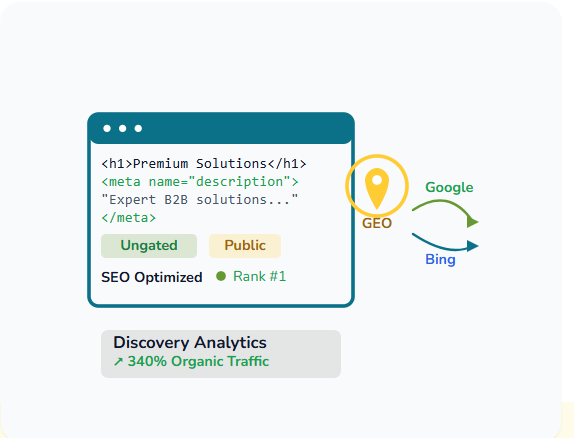
With SlateCX you can design your web content for maximum visibility. You can ungate your content so that search and AI engines give you higher rankings and more inclusion in AI answers.
Convert More Leads
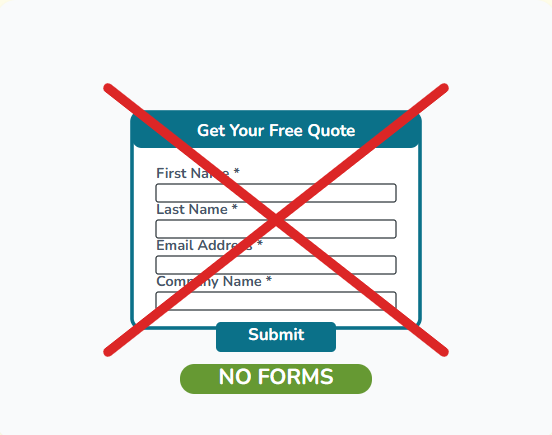
Experiment with removing forms and letting the SlateCX agent collect prospect information during the course of a natural conversation. Prospects engage more freely when they're not confronted with barriers, leading to higher quality leads and better conversion rates.
Increase Engagement
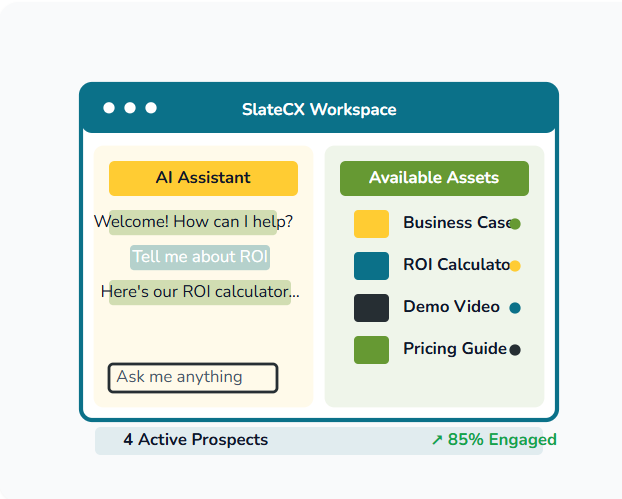
Keep prospects actively involved throughout their buyer journey. Interactive workspaces encourage exploration, team collaboration, and deeper engagement with your solutions.
Put Your Best Foot Forward
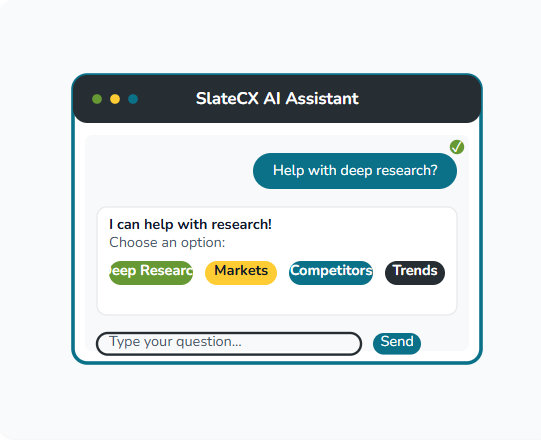
Your prospects want to do their own deep research - about solutions available to them and their strengths and weaknesses. With SlateCX they can do this while you supply the AI Agent with the most relevant information about your product and brand.
Help Your Reps Engage
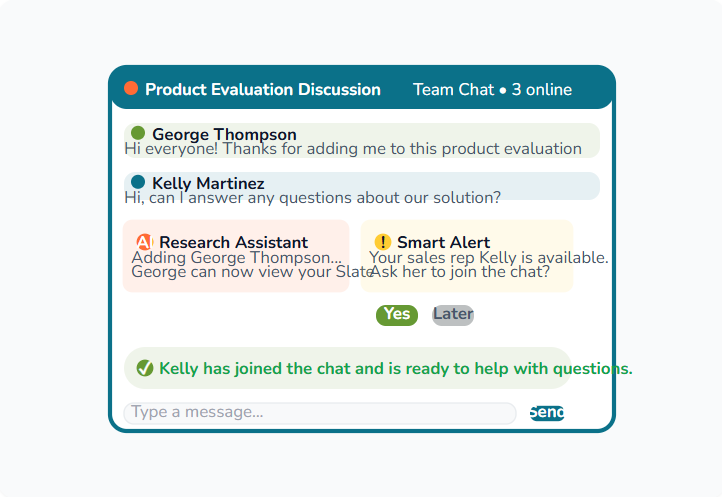
When prospects are actively engaged and ready for sales interaction, SlateCX automatically invites your sales rep to join the team chat at exactly the right moment. No more cold calls - your reps enter warm conversations with prospects who are already engaged.