-2.png?width=132&height=32&name=slatecx-logo%20(1)-2.png)

Your AI SDR books meetings. Can it answer the questions buyers ask?
Most AI SDR tools are built to do one thing: get the meeting. Useful, but not what a buyer needs when they are evaluating you. See how a typical AI SDR handles a real evaluation question, and what a Buyer Agent does instead.
Built on the Buyer Answer Gap study of 100+ B2B SaaS sites.
An AI SDR is built to book. A buyer is trying to evaluate.
There is nothing wrong with an AI SDR. Routing a warm lead to a rep is a real job, and a good AI SDR does it well. The problem is what happens when a serious buyer asks a real question, how does it work, what is the payback, can you prove the security claim. The AI SDR is not built to answer those. It is built to convert the question into a calendar invite.
So the buyer leaves without the answer they came for, and forms their view of you from review sites, forums, and competitor pages instead. That is the gap. A Buyer Agent closes it by answering the question from your own approved content, in the moment, the way a great rep would, without making the buyer book a call to get a straight answer.
Seven capabilities separate a chatbot from a Buyer Agent
This is not a feature comparison between similar tools. These are the capabilities that define the category difference, and they are what a buyer notices.
The first two rows you can test today: run the buyer test below against your live bot. The other five are what a Buyer Agent adds once answering is solved.
Two ways to go deeper
Grade your real AI SDR
Get the 12-question buyer test behind the Buyer Answer Gap study and run it against your live bot. In about fifteen minutes you will see exactly which buyer questions it answers and which it deflects.
Get the test →Try a Buyer Agent on your content
Get on the list for the Buyer Agent experience. We are onboarding design partners now and opening it up in stages. You will see a Buyer Agent answer the evaluation questions your AI SDR sends to a calendar.
Join the waitlist →Buyers evaluate you before they ever book a call
The AI on your site decides what they learn. Make sure it can answer, not just schedule.
Grade your real AI SDR →Evaluating AI SDR tools
What is an AI SDR? +
An AI SDR, or AI sales development representative, is software that handles the top of the sales funnel: greeting site visitors, qualifying them, answering basic questions, and booking meetings with a human rep. Its core job is to turn interest into a scheduled conversation. The best AI SDR tools do that routing well, which is different from answering a buyer’s deeper evaluation questions.
What is the difference between an AI SDR and an AI BDR? +
In practice the terms overlap, and both are sometimes marketed as an AI sales assistant. An AI SDR usually handles inbound, qualifying and routing people who land on your site. An AI BDR (business development representative) leans more outbound, prospecting and starting conversations with people who have not raised their hand yet. Both are built around getting to a meeting, so both face the same limit when a buyer wants a real answer rather than a calendar slot.
What should I look for in the best AI SDR tools? +
Beyond the usual checklist (integrations, routing, handoff to humans), test one thing most demos skip: ask it a real evaluation question, like how the product actually works or what the payback is for a company your size. See whether it answers with specifics from your content or deflects to a meeting. How a tool handles that question tells you how it will serve buyers who are evaluating you, not just the ones already ready to talk.
Can an AI SDR answer buyer due-diligence questions? +
Usually not well. Most AI SDRs are scripted to qualify and book, so when a buyer asks about security evidence, data ownership, ROI, or how the product works end to end, the common reply is to offer a call. That is by design. The questions buyers ask during evaluation are not what an AI SDR is built to answer, which is exactly the gap a Buyer Agent is meant to fill.
What is a Buyer Agent, and how is it different from an AI SDR? +
A Buyer Agent works for the buyer’s evaluation, not just the seller’s calendar. Instead of routing the visitor to a meeting, it answers the questions a serious buyer asks, drawn from your own approved content, and explains the mechanism rather than just claiming an outcome. An AI SDR optimizes for booking. A Buyer Agent optimizes for answering. The two can coexist: one routes the ready, the other serves the evaluating.
Should an AI SDR replace human sales reps? +
No. An AI SDR handles volume at the top of the funnel and hands warm, qualified buyers to people. The point is not to remove reps, it is to make sure buyers can get real answers before the handoff, so the conversation a rep does have starts further along.
Help Prospects Discover Your Website
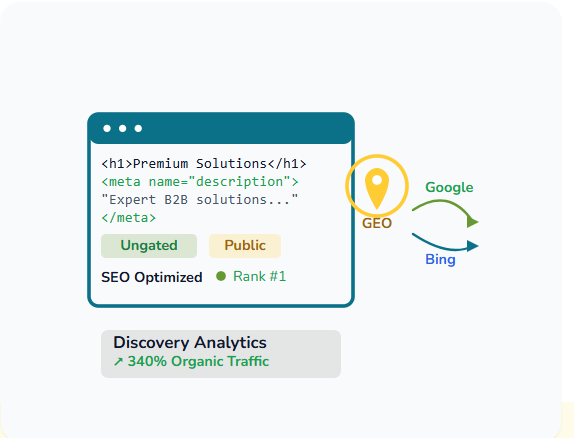
With SlateCX you can design your web content for maximum visibility. You can ungate your content so that search and AI engines give you higher rankings and more inclusion in AI answers.
Convert More Leads
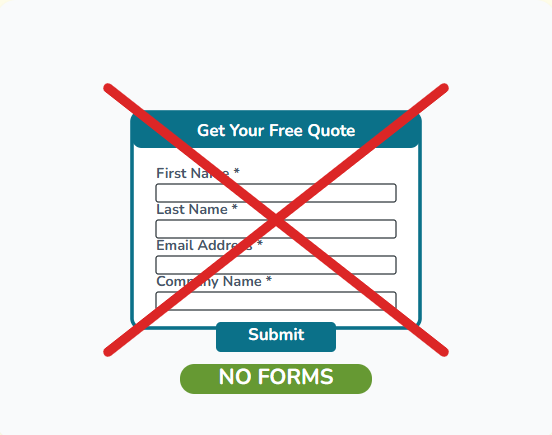
Experiment with removing forms and letting the SlateCX agent collect prospect information during the course of a natural conversation. Prospects engage more freely when they're not confronted with barriers, leading to higher quality leads and better conversion rates.
Increase Engagement
Keep prospects actively involved throughout their buyer journey. Interactive workspaces encourage exploration, team collaboration, and deeper engagement with your solutions.
Put Your Best Foot Forward
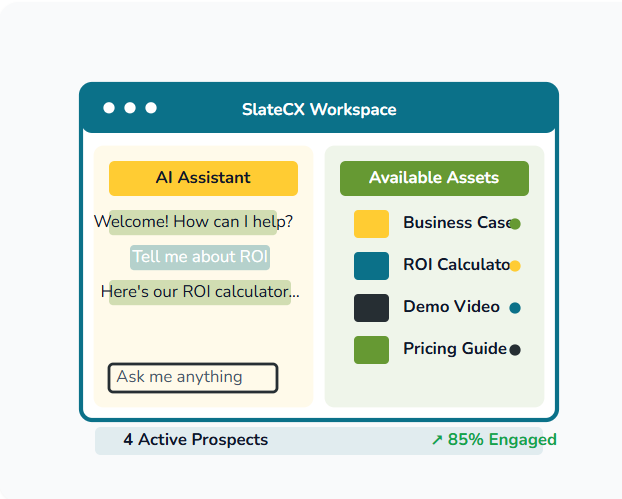
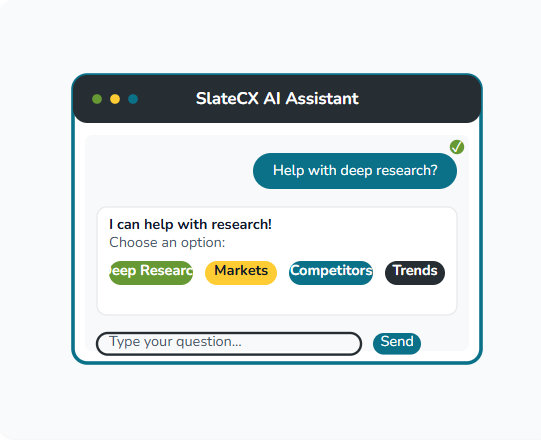
Your prospects want to do their own deep research - about solutions available to them and their strengths and weaknesses. With SlateCX they can do this while you supply the AI Agent with the most relevant information about your product and brand.
Help Your Reps Engage
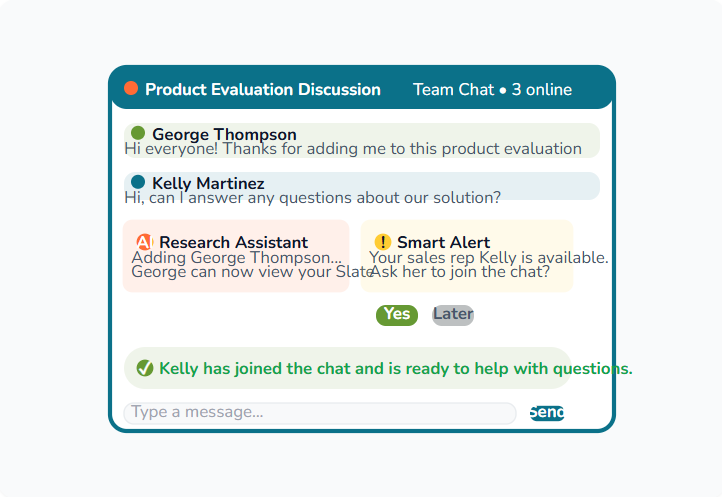
When prospects are actively engaged and ready for sales interaction, SlateCX automatically invites your sales rep to join the team chat at exactly the right moment. No more cold calls - your reps enter warm conversations with prospects who are already engaged.