-2.png?width=132&height=32&name=slatecx-logo%20(1)-2.png)

Personal Agent Protocol? What is it? Does it matter in B2B?

Callan Schebella
Personal Agent Protocol? What is it? Does it matter in B2B?
9:47
Last week Sierra, working with Meta, announced the Personal Agent Protocol (PAP), with Walmart, Shopify, Stripe and Genesys among the partners. It sets the rules for what happens when a customer sends their own AI agent to deal with a business on their behalf.
The largest consumer brands now expect a growing share of their customers to arrive as software. They want to know when that happens, and they want a say in what that software is allowed to do.
Most of what it covers is everyday consumer business. But it matters to two other groups as well. For companies selling complicated consumer purchases, such as solar panel installation or a mortgage refinance, it fits well, and we expect to support it once the specification is published. However, for B2B, it mostly does not apply, and I go into it in detail below.
What the protocol is for
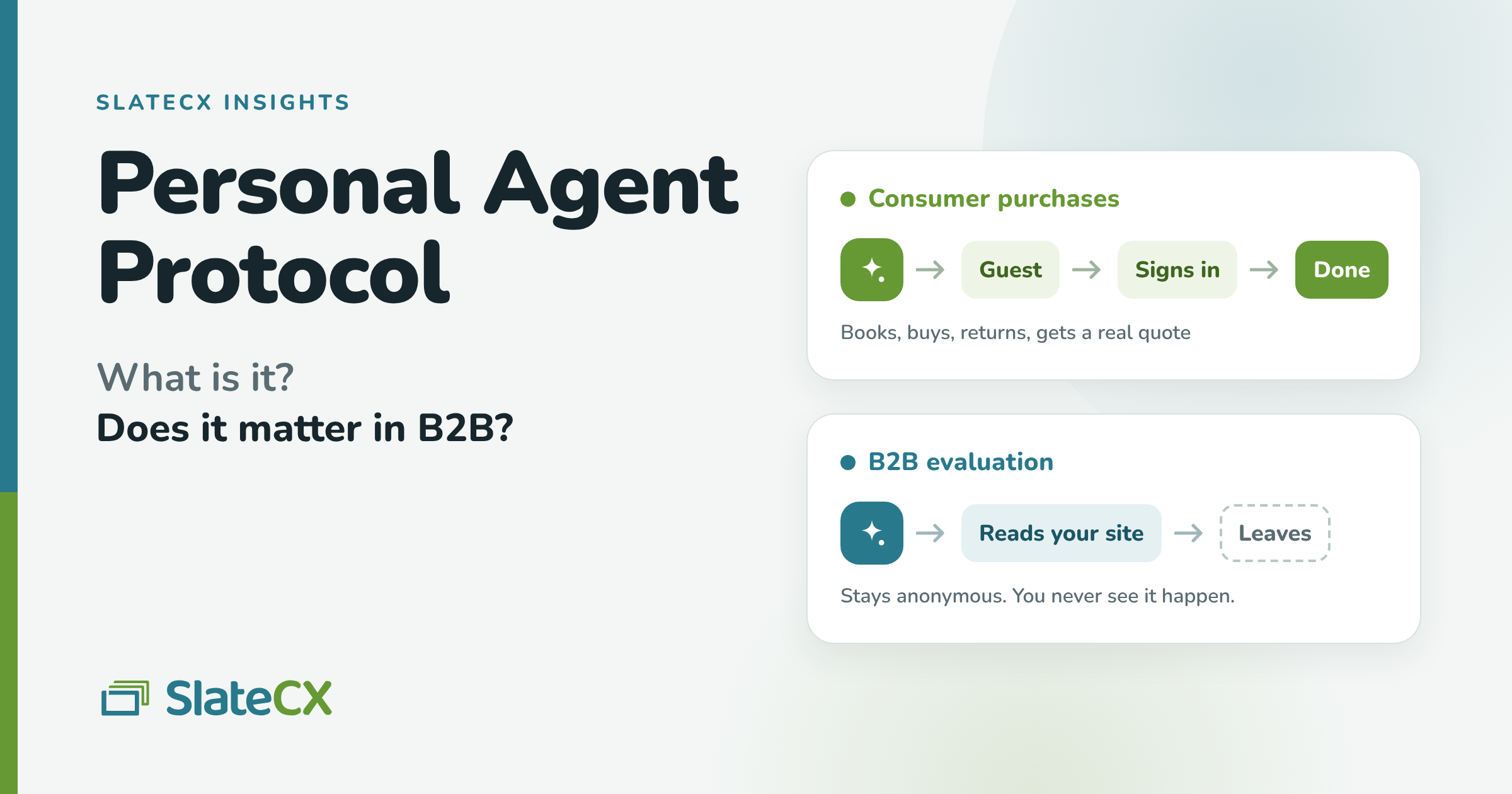
The protocol is built on OAuth, the same standard behind "sign in with Google." Here is the flow as Sierra describes it:
- The agent starts on the company's website, where it learns what the company offers and how to reach it.
- It can begin as a guest, which is enough to check stock or read a returns policy.
- When the task needs the customer's account, the customer signs in and decides whether the agent gets read-only or write access.
- The company decides which door the agent uses: its website, its APIs, or its own AI agent for anything that needs a conversation, such as a warranty claim.
If you look at the examples Sierra uses and the companies that signed on, the focus is clear. Sierra describes people using personal agents to schedule appointments, book flights and shop for car insurance. The partners are retailers and commerce platforms (Walmart, Shopify, Stripe), a contact center vendor (Genesys) and a home buying and mortgage company (Rocket). This is a protocol for consumer purchases, and for the customer service that comes after them.
For now, this is an announcement, not a standard. Sierra says the v0.1 specification will arrive later this month, along with design workshops and a reference implementation. Finer permissions, push notifications and payments are described as things that "could" come later. Nobody can implement it today.
Technology enabling behavioral changes
I am not a marketer. I spent twenty years building conversational AI for contact centers, and this announcement reads to me like something I have already lived through.
First came the IVR, the phone tree that sent callers around the same menu until they pressed zero. Then came AI that could hold a real conversation and actually resolve the call. Each time, customers changed their expectations well before companies changed their systems.
So, it is no surprise that Genesys, one of the largest contact center vendors, is a partner here. Its CEO, Tony Bates, described personal AI as "a new front door to the enterprise." People in my former industry have seen enough of these shifts to recognize the next one. The customer is not calling anymore. Their agent is.
Complex consumer purchases
There is one group of consumer businesses where the protocol fits especially well: the ones selling complicated, expensive decisions. For example: solar panel installation, mortgage refinance or a new roof.
These buyers research in much the same way as B2B buyers do. They have hard questions: what the payback is, how net metering works where they live, what happens if they sell the house in five years. The decision takes weeks, and usually a spouse or partner has to agree. A product page does not answer those questions, and a chatbot that offers to book a consultation does not either.
But unlike B2B buyers, at some point they want a real quote, and to get one they have to say who they are. That is exactly the guest-then-sign-in path the protocol describes. The customer's agent researches as a guest, and the customer signs in when they want numbers specific to them. So, it makes sense that Rocket is one of the launch partners.
For these businesses, the door that matters most is the third one: the company's own agent, for anything that needs a conversation. That is the kind of agent we build, one that answers hard questions from the company's own content. Once the specification is published, we expect to support the Personal Agent Protocol for consumer businesses like these, so a customer's agent can get real answers, first as a guest and then signed in.
Why it does not really apply to B2B
Will B2B get its own version? I doubt it.
Consider what the protocol is for. A consumer's agent signs in so it can do something: change a flight, return a sweater, reorder the groceries. Nobody will let an AI agent sign a $1M software contract. That decision runs through a buying committee, procurement, legal and a negotiation.
B2B buyers do not want to sign in anyway. Early in a purchase, they work hard to stay anonymous. They skip the forms and avoid sales until they have a shortlist.
So the B2B equivalent is not a protocol. It is the guest session, and it lasts for most of the buying process. The buyer's AI arrives without a name, reads what you have published, and helps decide whether you make the shortlist.
In consumer, the brand gets a front door and a chance to engage. In B2B, the agent never knocks. It reads your site and leaves.
What a B2B buyer's agent finds
What does that agent actually find? We wanted to know, so this summer we measured it.
We built 13 questions from Gartner's B2B buying jobs and standard security and RFP questionnaires, and froze them before grading a single site. Then we graded 130 B2B SaaS companies, 1,950 answers in all. Across the 108 sites we could fully grade, the results were:
- 55% of questions received no answer at all.
- 41% received a claim with no mechanism. "We lower costs." How?
- 4% received a full answer.
- 6% of sites made an honest case against a named competitor.
We then put the same questions to AI. 96% of the AI answers came from the vendor's own material.
That figure matters most here. Many marketers worry that AI describes them using content they do not control. Mostly, it does not. It reads the same pages the buyer reads. It usually has something to say, but rarely the specific answer a buyer needs, because that answer is not on the pages either.
The exception is the question that decides a shortlist. When the buyer asked why this vendor over a named competitor, AI often left the vendor's own material and built the comparison from review sites and someone else's comparison page. On that question, nearly a third of the answers came from third parties.
How it got there matters too. In our test, the AI did not read the whole site. It ran a few web searches, as a buyer's assistant would, and answered from what came back. So publishing an answer is only half the job. If it sits on a page that does not come up for the buyer's question, then as far as the agent is concerned, it does not exist.
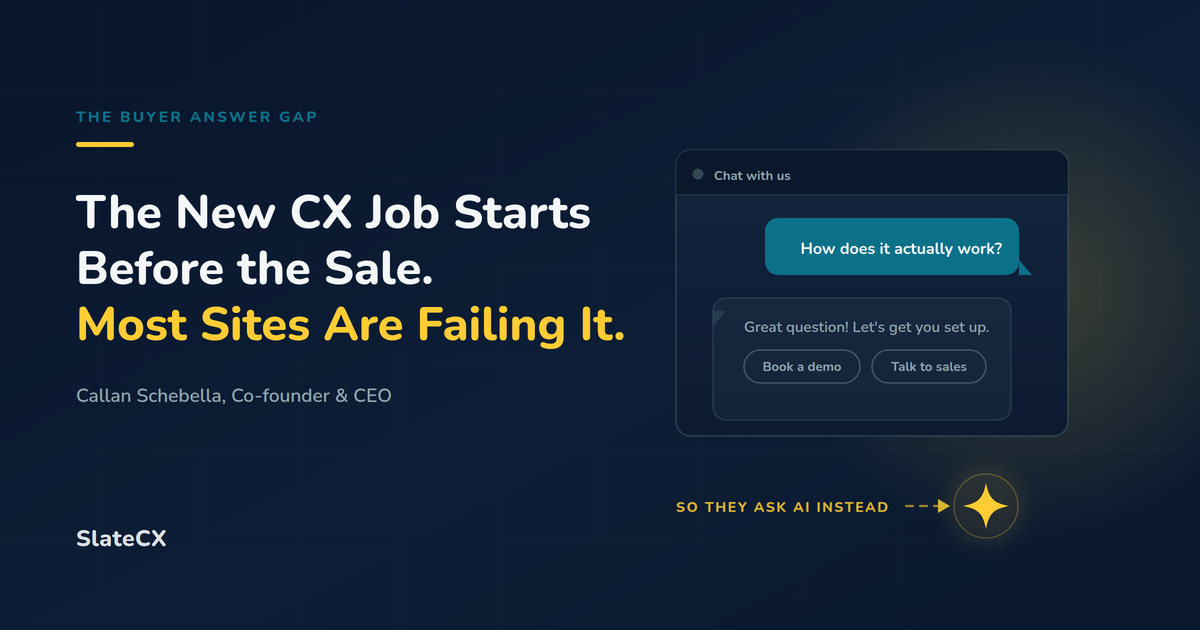
The chatbots were not much help either. Of 102 sites we checked, 41 had a chat widget, and only 7 of those gave a buyer a genuinely good answer. Most of the rest showed the buyer nothing at all. Others offered a button menu, asked for an email first, or were offline. Anyone from my world recognizes the button menu instantly: it is the IVR that loops the caller back to the main menu. A buyer's agent will not click through a menu or wait for someone to come online. It will simply move on, and nobody on your team will ever see it happen.
What B2B teams can do this quarter
None of this requires a protocol. Here is where I would begin.
- Find out what an agent sees. Ask ChatGPT or Claude the questions a buyer would ask about you, and compare the answers with what your sales team says on calls. Include why a buyer should choose you over your biggest rival, since that is where AI most often leaves your material. Or run our free grader on your site, which takes a few minutes.
- Put the mechanism on the page. Every "we lower costs" needs a "here is how." You cannot pre-write an answer to every buyer's question, but an agent can only use what you have published. The basics have to be there.
- Make your competitive case in public, and make it findable. If you only explain why you win on a sales call, an anonymous agent will never hear it. Someone else's comparison page will fill the gap. Title the page the way buyers search, such as "You vs. Them," so it comes up when the agent goes looking.
- Look at what sits behind your forms. An anonymous agent will not fill one out. Anything you gate is invisible to it, and to the buyer it works for.
- Give buyers somewhere to go when they are ready. No static page can answer the specific questions each buyer brings. That is what a buyer agent on your side is for. It answers from your own content and shows you the questions buyers actually ask, so evaluation stops being invisible. When a buyer is ready to bring in the committee, they raise their hand on their own terms.
The agent is already reading
Who knows how long the Personal Agent Protocol will take to settle. For complicated consumer purchases, we plan to be ready when it does. For B2B, you do not need a standard to fix this.
The buyer's agent is already reading your site this week. The only question is whether it finds anything worth reporting back.
Sources
- Introducing Personal Agent Protocol, Sierra, October 6, 2026
- The Buyer Answer Gap study, SlateCX