-2.png?width=132&height=32&name=slatecx-logo%20(1)-2.png)

What Every Marketer Should Know About the Protocols Rewiring AI

Callan Schebella
What Every Marketer Should Know About the Protocols Rewiring AI
10:14
There is a quiet standards race happening underneath the AI you use every day. It has nothing to do with which model is the smartest this month. It is about the pipes: the protocols that let AI agents find tools, talk to each other, and get real work done. The acronyms are so numerous, that some even refer to multiple industry initiatives! MCP. A2A. ACP. ANP. Most marketers have never heard of any of them.
You do not need to write a line of code to care about this. You should care because these standards are quietly deciding whether an AI can find your product, understand it, use what you have published, and act on it for a buyer. Put plainly, your marketing will need to become software infrastructure. It will not just be read by people. It will be queried, used, and negotiated with by the agents working for them. Let me attempt to translate what is happening, where it stands today, and where it is going.
Every new era of computing looks like this
When a new way of building software arrives, it always starts with a mess. A dozen competing standards show up, each claiming to be the one everyone will use. Then the market gets tired of the chaos, a couple of them win and the rest fade. It happened with enterprise software in the late 1990s, when a tangle of competing protocols eventually gave way to the plain, web-friendly approach we still use today. It happened again with real-time messaging.
AI agents are in the messy opening phase right now. In roughly the last eighteen months, four significant protocols have been published by Anthropic, IBM, Google, and an independent group.. Most of these protocols solve different problems and stack on top of each other rather than fighting for the same job. The confusion comes from marketing, where every one of them gets described as 'the standard for AI agents' without saying which part of the problem it handles.
The protocols, in plain language
Here is the whole landscape without the jargon.
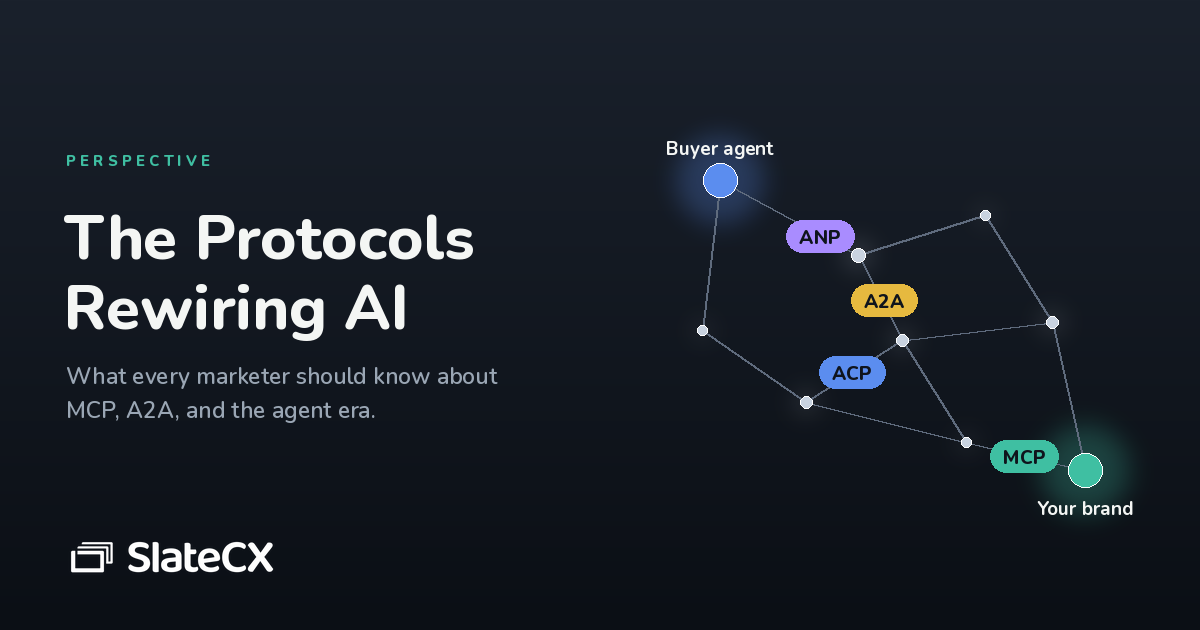
MCP (Model Context Protocol) is how an AI model uses a tool. It defines how a model discovers what a system can do, how to ask it to do something, and how to read the result back. Anthropic published it in late 2024, and it has been successuful. By early 2026 there were more than 10,000 public MCP connectors and the developer kit was being downloaded nearly a hundred million times a month. When people say a standard has 'won,' this is what it looks like.
A2A (Agent-to-Agent) is how two agents hand work to each other. Where MCP lets an agent pick up a tool, A2A lets one agent say to another, 'here is a task, go do your part, tell me when it is done.' Its clever idea is the Agent Card, which is basically a business card for an agent: a short, machine-readable profile that says what this agent can do and how to reach it. Google published A2A in April 2025 and handed it to a neutral foundation two months later. More than 150 organizations, including the big cloud and enterprise players, have lined up behind it.
Two others fill in the corners. ACP is a lightweight way for agents to pass simple messages when the full task-handoff machinery of A2A would be overkill. ANP handles identity and discovery: how an agent proves who it is and how other agents find it without a central directory. You do not need to track these closely. Just know the shape of the stack: something to discover agents, A2A to coordinate them, MCP to let them use tools, and light messaging underneath. All add value and are basically layers, not rivals.
How this already shows up in Claude and ChatGPT
You have probably used MCP without knowing it. When you connect Claude or ChatGPT to your Google Drive, your Slack, your Notion, or your company's CRM, that link runs on MCP underneath. Anthropic calls these Connectors and keeps a directory of them, several hundred now and growing, covering the everyday tools people work in: Drive, Slack, Notion, Stripe, and the like. ChatGPT calls its versions Apps, but it is the same standard beneath, which is why a company can build one connector and offer it in both places.
There are two flavors, and the difference is the part marketers should sit with. The first is the public marketplace: a browsable store of ready-made connectors for well-known products, the AI equivalent of an app store. The second is the custom connector, where a business wires its own systems into the AI, its product catalog, its documentation, its pricing, so the assistant can answer questions grounded in that company's real information instead of guessing.
That second flavor is the one that changes marketing. It means the raw material you already produce, your answers, your proof, your product detail, can become something an AI reaches into directly and speaks from. The brands that make that material open and clear are the ones the AI can represent well. The brands that keep it trapped in a slide deck or behind a form leave the AI to improvise, and it will improvise from your competitor's content.
Where things stand today
The top of the stack is basically settled. MCP is stable, widely adopted, and safe to build on. A2A is a bit younger but moving fast and backed by nearly everyone, so building on it now is a reasonable bet as long as you appreciate that it's still maturing.
The part that is not finished is the plumbing underneath, the layer that lets two agents open a direct connection to each other across the messy reality of the internet. Almost every device sits behind a home or corporate network that does not accept incoming connections, so today most agent traffic gets funneled through middlemen servers. That works, but it adds cost, delay, and possible single point failures. The industry knows how to fix this, and the tools exist, but this layer is probably a year and a half to two years behind the rest. Expect it to settle sometime around 2027 to 2028.
If you take one thing from the state of play, take this: the ability for AI agents to talk to tools and to each other is no longer theoretical. It is shipping. The only real question left is how smoothly they connect, not whether they will.
Why this matters for marketers
Here is where it stops being an engineering story and becomes yours.
Buyers have already changed how they evaluate you. More and more of them start with an AI assistant instead of a search engine. They ask questions like ‘How do I solve this problem? , Or ‘How does Company X compare to Company Y?’ to determine whether you are worth a demo. The AI will answer and if your own material is thin, gated, or written only for a human skimming a homepage, the AI fills the gap with whatever it can find: review sites, Reddit, your competitor's comparison page. To put it another way, you are being evaluated in a room that you are not standing in.
These protocols are what turn that trend from a search habit into an ecosystem. MCP means your product information can become something an AI is allowed to reach into and use directly, the way it reaches any other tool. A2A means the buyer's agent can eventually talk to your agent, ask pointed questions, and get real answers on your behalf. In that world your marketing is not just a set of pages a person reads. It is a source an AI queries, and increasingly a counterpart another agent negotiates with.
That is a genuine shift in what 'being findable' means. For twenty years we optimized for a human clicking a link and for a search engine ranking a page. The next decade adds a third audience that never sees your design and never reads your tagline: an agent acting for your buyer, deciding in seconds whether you belong on the shortlist, based entirely on whether it can get a clear, specific answer out of you.
Where it is going
Two directions are worth watching. First, consolidation. Over the next year or so the top layers harden into secure and dependable standards, which is exactly what you want from any plumbing. Second, discovery by capability. Instead of finding a company by its web address, agents will increasingly find each other by what they can do: 'which agents can answer detailed security questions about a CRM,' 'which agents can price a mid-market deal.' That is much closer to a live directory of capabilities than to today's search results.
Put those together and you get a near future where a buyer's agent goes looking not for your website but for an agent that can speak for you, and either finds one that answers well or moves on to a vendor whose agent does. The companies with the most leverage when that arrives will be the ones who started making their answers reachable and machine-usable now, while it is cheap, instead of retrofitting it later under pressure.
What to do this quarter
You do not need a protocol team. You need to start treating agents as a real audience. So:
- Assume your first visitor is an agent, not a person. Ask a simple question: if an AI reads your site, could it answer what you cost, how you compare, and how you work day to day?.
- Ungate and structure your best answers. The material buyers most want is often trapped behind a form or buried in a PDF. An agent will not fill out your form. It will just use whatever is open, which today is usually your competitor's content.
- Give your brand something an agent can talk to. A real assistant on your own turf, one that answers the hard questions instead of routing to 'book a demo,' is how you stay in the conversation..
The bottom line
The plumbing of the agent era is being laid right now, mostly by engineers, mostly out of view. It is tempting to file it under 'not my job.' That would be a mistake. These standards are about to decide who AI can recommend and who it quietly skips. The marketers who understand that early, and make their brand something agents can find and use, will own the shelf space in a store their competitors do not yet know exists.